 Animal Ears
 🦆 How animals hear
Duck hearing range in hertz
Anas platyrhynchos
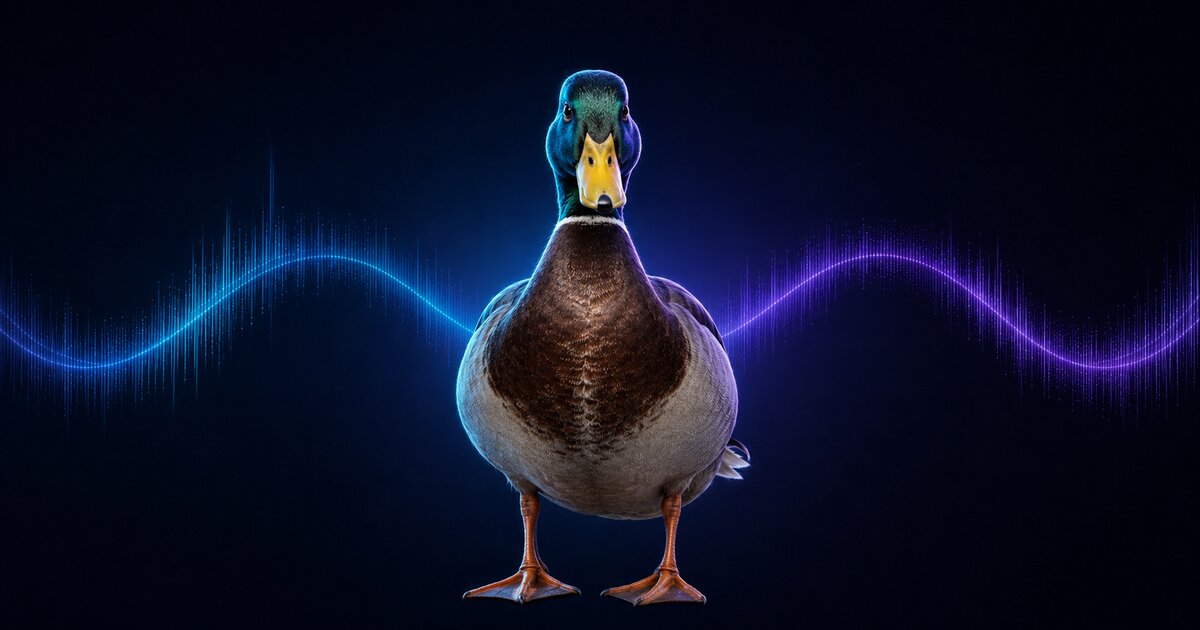
Sensible bird hearing: no extremes, all of it in quacking territory.

In short
A Duck hears from about 66 Hz up to 7.6 kHz, and the pitch it catches best is near 2 kHz. Animal Ears lets you take any sound of yours and hear it exactly as it would.
The mallard hears from 66 to 7,600 Hz, with its best zone at 2,000: fairly typical bird hearing, with no extremes at either end. It doesn't detect infrasound, unlike the pigeon, and it doesn't reach your highs either. Its thing is the middle band, the one that holds quacks, splashes and beating wings, which is exactly where a duck's life happens.
Hertz (Hz)
Which pitches it hears
Hertz count how many times per second a sound vibrates. Few vibrations = low (the rumble of thunder, about 30 Hz). Many vibrations = high (a microwave beeping, about 3,000 Hz). And ‘1 kHz' is just shorthand for 1,000 Hz. You hear, roughly, from 20 Hz to 20,000 Hz.
A low sound rumbles (think thunder); a high sound squeals (think a mosquito). These three numbers mark how far down this animal goes, how far up it goes, and which pitch it hears most clearly of all.
| Lowest it hears | 66 Hz |
|---|---|
| Highest it hears | 7.6 kHz |
| Hears most clearly | 2 kHz |
| What you hear | 20 Hz – 20 kHz |
Your ears vs a Duck's
It does miss the highs you can hear, though: above about 7.6 kHz there is nothing left for it.
Audiogram
| Hertz (Hz) | Hearing threshold |
|---|---|
| 100 Hz | 52 dB |
| 250 Hz | 38 dB |
| 500 Hz | 25 dB |
| 1 kHz | 15 dB |
| 2 kHz | 9 dB |
| 3 kHz | 11 dB |
| 4 kHz | 18 dB |
| 6 kHz | 38 dB |
| 8 kHz | 55 dB |
In-air behavioural audiogram (dB SPL); best ~2 kHz; digitised approximation of the classic Trainer (1946) curve compiled in Fay (1988). A 2017 mallard audiogram (doi:10.1007/s00359-017-1204-6) reports 66 Hz–7.6 kHz; mallards do not detect infrasound.
Can a Duck hear things you can't?
A Duck picks up everything from 66 Hz (the deepest) to 7.6 kHz (the highest), and hears best around 2 kHz.
It does miss the highs you can hear, though: above about 7.6 kHz there is nothing left for it.
Frequently asked questions
What sounds can a Duck hear?
A Duck picks up everything from 66 Hz (the deepest) to 7.6 kHz (the highest), and hears best around 2 kHz.
Can a Duck hear things you can't?
It does miss the highs you can hear, though: above about 7.6 kHz there is nothing left for it.
How does Animal Ears make a sound like a Duck would hear it?
Scientists have measured, pitch by pitch, the quietest volume at which a Duck starts to hear each sound. We take that curve and apply it to your recording like a giant equaliser: we turn up the pitches the animal hears beautifully and turn down or remove the ones that simply don't exist for it. The result gets close to what it would notice... but it still arrives through your ears.
Hertz (Hz)
Hertz count how many times per second a sound vibrates. Few vibrations = low (the rumble of thunder, about 30 Hz). Many vibrations = high (a microwave beeping, about 3,000 Hz). And ‘1 kHz' is just shorthand for 1,000 Hz. You hear, roughly, from 20 Hz to 20,000 Hz.
Where these numbers come from
- Trainer, J.E. (1946). The auditory acuity of certain birds. PhD dissertation, Cornell (in Fay 1988).
- Dooling, R.J., Lohr, B. & Dent, M.L. (2000). Hearing in birds and reptiles. Springer Handbook of Auditory Research 13, 308–359. doi:10.1007/978-1-4612-1182-2_7
More animals
Chicken
It misses your highs, but it drops to rumbles you never even brush.

Hummingbird
It sings notes higher than it can actually hear.
Penguin
It finds its partner by voice among thousands of penguins all shouting at once.
Eagle
Champion eyesight, ordinary ears: it catches fewer highs than you do.
Animal Ears
Get Animal Ears
Upload a sound of your own and hear it exactly as an animal would.