 Animal Ears
 🐔 How animals hear
Chicken hearing range in hertz
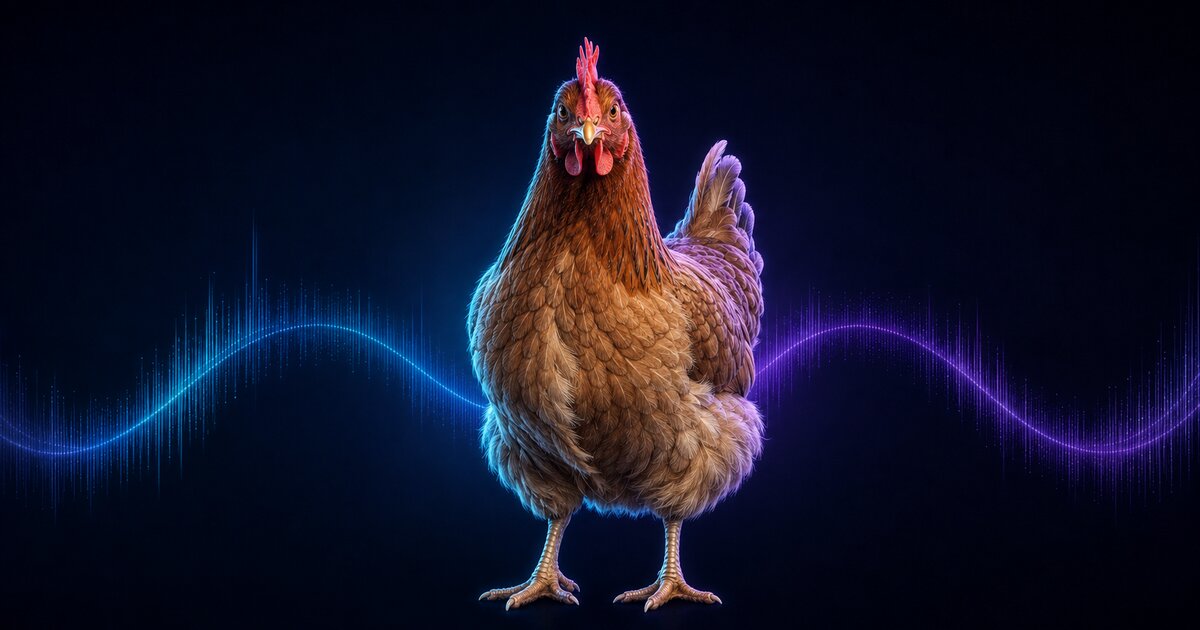
Gallus gallus domesticus
It misses your highs, but it drops to rumbles you never even brush.

In short
A Chicken hears from about 9 Hz up to 7.2 kHz, and the pitch it catches best is near 2 kHz. Animal Ears lets you take any sound of yours and hear it exactly as it would.
A hen falls short at the top — it reaches 7,200 Hz, a long way from your 20,000 — but it surprises you at the bottom: it picks up down to about 9 Hz, a rumble so deep it's practically silence to you. Its best zone is 2,000 Hz, the zone of its clucking and of chicks peeping. That deep hearing gives it access to a background world we miss completely.
Hertz (Hz)
Which pitches it hears
Hertz count how many times per second a sound vibrates. Few vibrations = low (the rumble of thunder, about 30 Hz). Many vibrations = high (a microwave beeping, about 3,000 Hz). And ‘1 kHz' is just shorthand for 1,000 Hz. You hear, roughly, from 20 Hz to 20,000 Hz.
A low sound rumbles (think thunder); a high sound squeals (think a mosquito). These three numbers mark how far down this animal goes, how far up it goes, and which pitch it hears most clearly of all.
| Lowest it hears | 9 Hz |
|---|---|
| Highest it hears | 7.2 kHz |
| Hears most clearly | 2 kHz |
| What you hear | 20 Hz – 20 kHz |
Your ears vs a Chicken's
Yes: it picks up rumbles so deep you would, at most, feel them in your chest, down to about 9 Hz. Your floor is 20 Hz. It does miss the highs you can hear, though: above about 7.2 kHz there is nothing left for it.
Audiogram
| Hertz (Hz) | Hearing threshold |
|---|---|
| 10 Hz | 58 dB |
| 64 Hz | 40 dB |
| 125 Hz | 30 dB |
| 250 Hz | 22 dB |
| 500 Hz | 13 dB |
| 1 kHz | 6 dB |
| 2 kHz | 3 dB |
| 4 kHz | 18 dB |
| 6 kHz | 38 dB |
| 8 kHz | 55 dB |
Behavioural audiogram (Hill et al. 2014); best ~3 dB at 2 kHz, 9.1 Hz–7.2 kHz at 60 dB SPL; good infrasound sensitivity below 64 Hz.
Can a Chicken hear things you can't?
A Chicken picks up everything from 9 Hz (the deepest) to 7.2 kHz (the highest), and hears best around 2 kHz.
Yes: it picks up rumbles so deep you would, at most, feel them in your chest, down to about 9 Hz. Your floor is 20 Hz. It does miss the highs you can hear, though: above about 7.2 kHz there is nothing left for it.
Frequently asked questions
What sounds can a Chicken hear?
A Chicken picks up everything from 9 Hz (the deepest) to 7.2 kHz (the highest), and hears best around 2 kHz.
Can a Chicken hear things you can't?
Yes: it picks up rumbles so deep you would, at most, feel them in your chest, down to about 9 Hz. Your floor is 20 Hz. It does miss the highs you can hear, though: above about 7.2 kHz there is nothing left for it.
How does Animal Ears make a sound like a Chicken would hear it?
Scientists have measured, pitch by pitch, the quietest volume at which a Chicken starts to hear each sound. We take that curve and apply it to your recording like a giant equaliser: we turn up the pitches the animal hears beautifully and turn down or remove the ones that simply don't exist for it. The result gets close to what it would notice... but it still arrives through your ears.
Hertz (Hz)
Hertz count how many times per second a sound vibrates. Few vibrations = low (the rumble of thunder, about 30 Hz). Many vibrations = high (a microwave beeping, about 3,000 Hz). And ‘1 kHz' is just shorthand for 1,000 Hz. You hear, roughly, from 20 Hz to 20,000 Hz.
Infrasound
Sounds so deep your ears no longer register them: below about 20 Hz. Rather than hearing them, you'd feel a tremor in your chest, like a heavy lorry going past. Elephants and pigeons do sense them, even from miles away.
Where these numbers come from
- Hill, E.M. et al. (2014). Audiogram of the chicken from 2 Hz to 9 kHz. J. Comp. Physiol. A, 200, 863–870. doi:10.1007/s00359-014-0929-8
- Saunders, J.C. & Salvi, R.J. (1993). Psychoacoustics of normal adult chickens. J. Acoust. Soc. Am., 94(1), 83–90. doi:10.1121/1.406946
More animals



Animal Ears
Get Animal Ears
Upload a sound of your own and hear it exactly as an animal would.