 Animal Ears
 🐟 How animals hear
Clownfish hearing range in hertz
Amphiprion ocellaris
Its larvae listen for a reef crackling to find their way home.

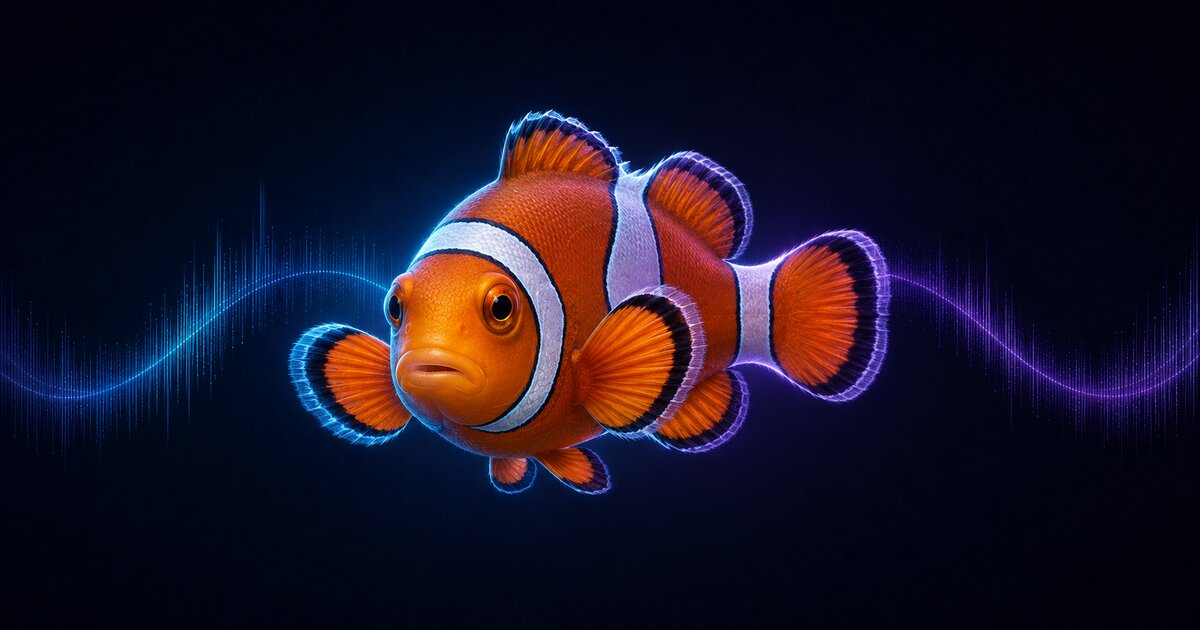
In short
A Clownfish hears from about 75 Hz up to 1.8 kHz, and the pitch it catches best is near 75 Hz. Animal Ears lets you take any sound of yours and hear it exactly as it would.
The clownfish listens to a narrow, low band, 75 to 1,800 Hz, and most likely feels the water moving rather than the pressure. The fascinating part is what it's for: a coral reef makes noise — crustaceans snapping, fish biting, a constant crackle — and its larvae, which are born and drift out to open sea, seem to use that noise as a beacon to get home.
Hertz (Hz)
Which pitches it hears
Hertz count how many times per second a sound vibrates. Few vibrations = low (the rumble of thunder, about 30 Hz). Many vibrations = high (a microwave beeping, about 3,000 Hz). And ‘1 kHz' is just shorthand for 1,000 Hz. You hear, roughly, from 20 Hz to 20,000 Hz.
A low sound rumbles (think thunder); a high sound squeals (think a mosquito). These three numbers mark how far down this animal goes, how far up it goes, and which pitch it hears most clearly of all.
| Lowest it hears | 75 Hz |
|---|---|
| Highest it hears | 1.8 kHz |
| Hears most clearly | 75 Hz |
| What you hear | 20 Hz – 20 kHz |
Your ears vs a Clownfish's
It does miss the highs you can hear, though: above about 1.8 kHz there is nothing left for it.
Audiogram
| Hertz (Hz) | Hearing threshold |
|---|---|
| 75 Hz | 96 dB |
| 100 Hz | 98 dB |
| 150 Hz | 100 dB |
| 200 Hz | 103 dB |
| 300 Hz | 108 dB |
| 400 Hz | 116 dB |
| 600 Hz | 124 dB |
| 800 Hz | 131 dB |
| 1 kHz | 137 dB |
| 1.8 kHz | 146 dB |
AEP thresholds in dB re 1 µPa measured in a tank near-field; anemonefish lack hearing specialisations and likely respond to particle motion — treat as an approximate pressure-referenced EQ shape.
Can a Clownfish hear things you can't?
A Clownfish picks up everything from 75 Hz (the deepest) to 1.8 kHz (the highest), and hears best around 75 Hz.
It does miss the highs you can hear, though: above about 1.8 kHz there is nothing left for it.
Frequently asked questions
What sounds can a Clownfish hear?
A Clownfish picks up everything from 75 Hz (the deepest) to 1.8 kHz (the highest), and hears best around 75 Hz.
Can a Clownfish hear things you can't?
It does miss the highs you can hear, though: above about 1.8 kHz there is nothing left for it.
How does Animal Ears make a sound like a Clownfish would hear it?
Scientists have measured, pitch by pitch, the quietest volume at which a Clownfish starts to hear each sound. We take that curve and apply it to your recording like a giant equaliser: we turn up the pitches the animal hears beautifully and turn down or remove the ones that simply don't exist for it. The result gets close to what it would notice... but it still arrives through your ears.
Hertz (Hz)
Hertz count how many times per second a sound vibrates. Few vibrations = low (the rumble of thunder, about 30 Hz). Many vibrations = high (a microwave beeping, about 3,000 Hz). And ‘1 kHz' is just shorthand for 1,000 Hz. You hear, roughly, from 20 Hz to 20,000 Hz.
Where these numbers come from
- Parmentier, E., Colleye, O. & Mann, D. (2009). Hearing ability in three clownfish species. J. Exp. Biol., 212, 2023–2026. doi:10.1242/jeb.030270
- Wright, K.J. et al. (2005). Auditory and olfactory abilities of a coral reef damselfish. Marine Biology, 147, 1425–1434. doi:10.1007/s00227-005-0028-z
More animals
Dragonfish
A listener from the abyss: we know so little that this is an honest hypothesis.
Shark
Only lows interest it: a wounded fish thrashing hundreds of metres away.
Goldfish
Top of the class among fish: it comes with a built-in amplifier.
Jumping spider
No ears, yet it hears a wasp across the room... with its legs.
Animal Ears
Get Animal Ears
Upload a sound of your own and hear it exactly as an animal would.