 Animal Ears
 🦝 How animals hear
Raccoon hearing range in hertz
Procyon lotor
Its broad in-air range reaches 40,000 Hz, while its most sensitive measured point sits near 1,000 Hz.


In short
A Raccoon hears from about 100 Hz up to 40 kHz, and the pitch it catches best is near 1 kHz. Animal Ears lets you take any sound of yours and hear it exactly as it would.
A raccoon hears airborne tones from about 100 to 40,000 Hz at the study's 60 dB criterion, roughly twice the usual human high-frequency ceiling. Its lowest measured threshold is near 1,000 Hz — around the upper notes of a piano — while the published curve has another sensitive region near 8,000 Hz. This comes from a behavioural pure-tone study; Animal Ears turns the curve's relative shape into EQ, not a literal copy of what a raccoon experiences.
Hertz (Hz)
Which pitches it hears
Hertz count how many times per second a sound vibrates. Few vibrations = low (the rumble of thunder, about 30 Hz). Many vibrations = high (a microwave beeping, about 3,000 Hz). And ‘1 kHz' is just shorthand for 1,000 Hz. You hear, roughly, from 20 Hz to 20,000 Hz.
A low sound rumbles (think thunder); a high sound squeals (think a mosquito). These three numbers mark how far down this animal goes, how far up it goes, and which pitch it hears most clearly of all.
| Lowest it hears | 100 Hz |
|---|---|
| Highest it hears | 40 kHz |
| Hears most clearly | 1 kHz |
| What you hear | 20 Hz – 20 kHz |
Your ears vs a Raccoon's
Yes: it picks up pitches so high they are pure silence to you, up to about 40 kHz. Your ceiling is 20 kHz.
Audiogram
| Hertz (Hz) | Hearing threshold |
|---|---|
| 100 Hz | 28 dB |
| 200 Hz | 16 dB |
| 500 Hz | 1 dB |
| 1 kHz | -12 dB |
| 2 kHz | -10 dB |
| 4 kHz | -5 dB |
| 8 kHz | -10 dB |
| 16 kHz | 0 dB |
| 20 kHz | 10 dB |
| 32 kHz | 0 dB |
| 40 kHz | 30 dB |
| 50 kHz | 80 dB |
In-air behavioural pure-tone audiogram, dB SPL re 20 µPa. Rounded digitisation of Wollack (1965) as reproduced by Ghoul & Reichmuth (2014): ~100 Hz–40 kHz at the 60 dB criterion, with the lowest measured threshold near 1 kHz. The relative EQ models only threshold-curve shape; it is not a literal reconstruction of raccoon hearing.
Can a Raccoon hear things you can't?
A Raccoon picks up everything from 100 Hz (the deepest) to 40 kHz (the highest), and hears best around 1 kHz.
Yes: it picks up pitches so high they are pure silence to you, up to about 40 kHz. Your ceiling is 20 kHz.
Frequently asked questions
What sounds can a Raccoon hear?
A Raccoon picks up everything from 100 Hz (the deepest) to 40 kHz (the highest), and hears best around 1 kHz.
Can a Raccoon hear things you can't?
Yes: it picks up pitches so high they are pure silence to you, up to about 40 kHz. Your ceiling is 20 kHz.
How does Animal Ears make a sound like a Raccoon would hear it?
Scientists have measured, pitch by pitch, the quietest volume at which a Raccoon starts to hear each sound. We take that curve and apply it to your recording like a giant equaliser: we turn up the pitches the animal hears beautifully and turn down or remove the ones that simply don't exist for it. The result gets close to what it would notice... but it still arrives through your ears.
Hertz (Hz)
Hertz count how many times per second a sound vibrates. Few vibrations = low (the rumble of thunder, about 30 Hz). Many vibrations = high (a microwave beeping, about 3,000 Hz). And ‘1 kHz' is just shorthand for 1,000 Hz. You hear, roughly, from 20 Hz to 20,000 Hz.
Ultrasound
Sounds so high your ears no longer register them: above about 20,000 Hz. To you they are total silence, but a dog, a cat or a bat hears them perfectly. That's exactly where a ‘silent' dog whistle lives.
Where these numbers come from
- Wollack, C.H. (1965). Auditory thresholds in the raccoon (Procyon lotor). Journal of Auditory Research, 5, 139–144.
- Ghoul, A. & Reichmuth, C. (2014). Hearing in the sea otter (Enhydra lutris): auditory profiles for an amphibious marine carnivore. Journal of Comparative Physiology A. doi:10.1007/s00359-014-0943-x (Fig. 4 reproduces the Wollack raccoon audiogram).
More animals
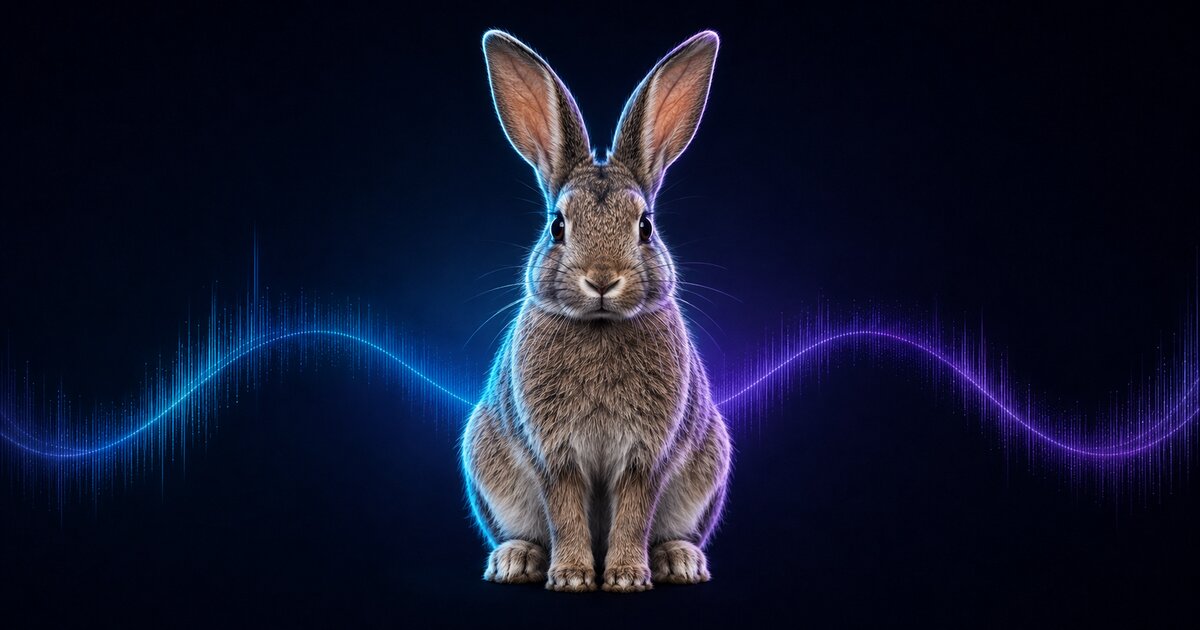
Rabbit
Its ears are giant funnels: they gather danger long before it comes into view.

Goat
It hears ultrasound, yet it's sharpest exactly where a kid's bleat sits.

Horse
Ears that swivel 180° independently: it listens behind its back without moving.
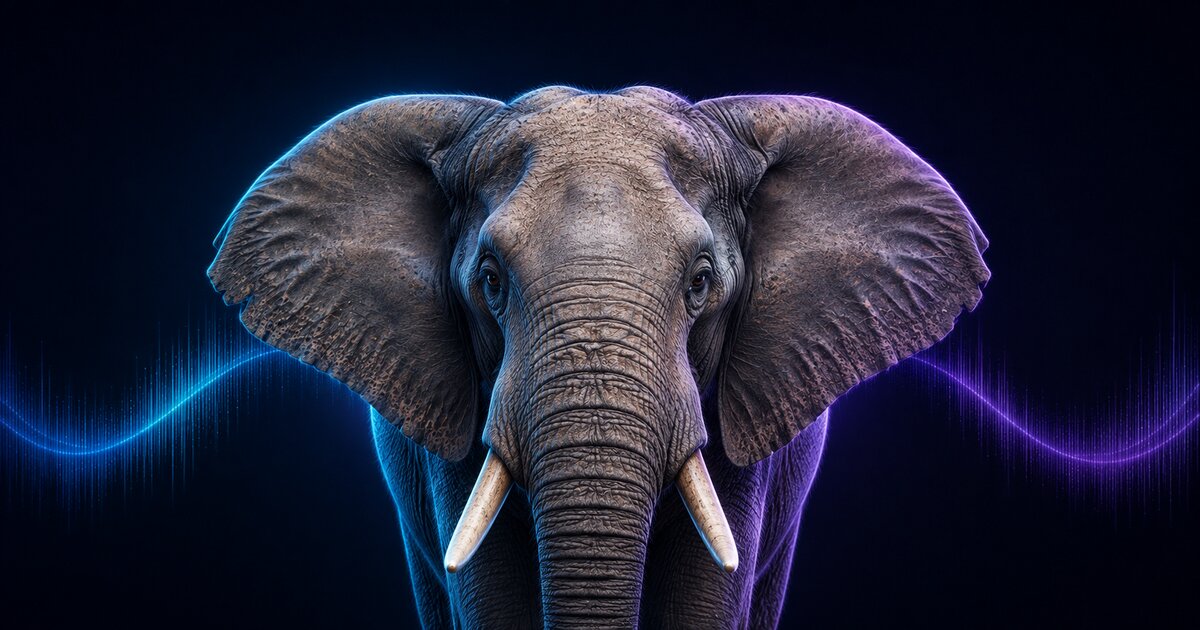
Elephant
It talks in rumbles so deep they travel for miles and you barely feel them.
Animal Ears
Get Animal Ears
Upload a sound of your own and hear it exactly as an animal would.