 Animal Ears
 🐊 How animals hear
Crocodile hearing range in hertz
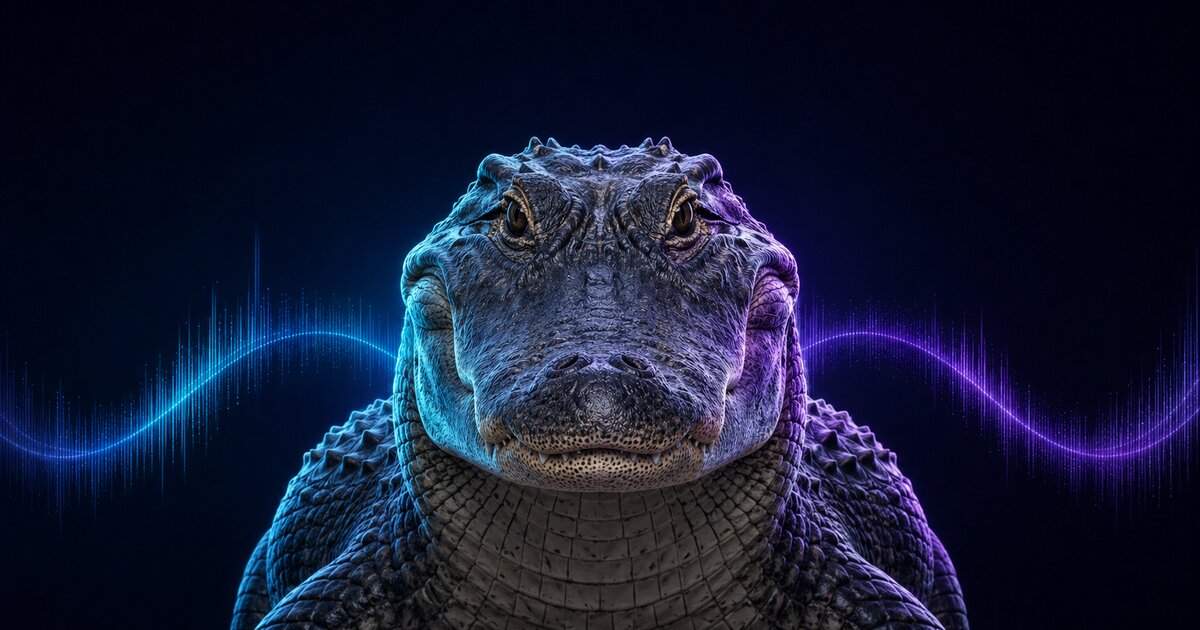
Alligator mississippiensis
A mother who digs out the nest the moment she hears her young peeping.

In short
A Crocodile hears from about 100 Hz up to 4 kHz, and the pitch it catches best is near 1 kHz. Animal Ears lets you take any sound of yours and hear it exactly as it would.
The American alligator hears quite well for a reptile: 100 to 4,000 Hz, with its best zone at 1,000 Hz, thanks to a genuine eardrum protected by a flap of skin that closes when it submerges. That band is precisely where adult bellows and hatchling peeps sit, two conversations that carry through water and even through the mud of a nest.
Hertz (Hz)
Which pitches it hears
Hertz count how many times per second a sound vibrates. Few vibrations = low (the rumble of thunder, about 30 Hz). Many vibrations = high (a microwave beeping, about 3,000 Hz). And ‘1 kHz' is just shorthand for 1,000 Hz. You hear, roughly, from 20 Hz to 20,000 Hz.
A low sound rumbles (think thunder); a high sound squeals (think a mosquito). These three numbers mark how far down this animal goes, how far up it goes, and which pitch it hears most clearly of all.
| Lowest it hears | 100 Hz |
|---|---|
| Highest it hears | 4 kHz |
| Hears most clearly | 1 kHz |
| What you hear | 20 Hz – 20 kHz |
Your ears vs a Crocodile's
It does miss the highs you can hear, though: above about 4 kHz there is nothing left for it.
Audiogram
| Hertz (Hz) | Hearing threshold |
|---|---|
| 100 Hz | 75 dB |
| 200 Hz | 62 dB |
| 400 Hz | 52 dB |
| 600 Hz | 47 dB |
| 800 Hz | 44 dB |
| 1 kHz | 44 dB |
| 1.5 kHz | 52 dB |
| 2 kHz | 63 dB |
| 3 kHz | 79 dB |
| 4 kHz | 91 dB |
In-air thresholds (dB re 20 µPa) approximated from auditory-evoked-potential data; crocodilians have a functional tympanic ear, best ~1 kHz. Higgs et al. measured in-air responses to ~8 kHz; the 4 kHz cap reflects the more sensitive band.
Can a Crocodile hear things you can't?
A Crocodile picks up everything from 100 Hz (the deepest) to 4 kHz (the highest), and hears best around 1 kHz.
It does miss the highs you can hear, though: above about 4 kHz there is nothing left for it.
Frequently asked questions
What sounds can a Crocodile hear?
A Crocodile picks up everything from 100 Hz (the deepest) to 4 kHz (the highest), and hears best around 1 kHz.
Can a Crocodile hear things you can't?
It does miss the highs you can hear, though: above about 4 kHz there is nothing left for it.
How does Animal Ears make a sound like a Crocodile would hear it?
Scientists have measured, pitch by pitch, the quietest volume at which a Crocodile starts to hear each sound. We take that curve and apply it to your recording like a giant equaliser: we turn up the pitches the animal hears beautifully and turn down or remove the ones that simply don't exist for it. The result gets close to what it would notice... but it still arrives through your ears.
Hertz (Hz)
Hertz count how many times per second a sound vibrates. Few vibrations = low (the rumble of thunder, about 30 Hz). Many vibrations = high (a microwave beeping, about 3,000 Hz). And ‘1 kHz' is just shorthand for 1,000 Hz. You hear, roughly, from 20 Hz to 20,000 Hz.
Where these numbers come from
- Higgs, D.M. et al. (2002). Amphibious auditory responses of the American alligator. J. Comp. Physiol. A, 188, 217–223. doi:10.1007/s00359-002-0296-8
- Wever, E.G. (1971). Hearing in the Crocodilia. PNAS, 68, 1498–1500. doi:10.1073/pnas.68.7.1498
More animals
Animal Ears
Get Animal Ears
Upload a sound of your own and hear it exactly as an animal would.