 Animal Ears
 🦇 How animals hear
Bat hearing range in hertz
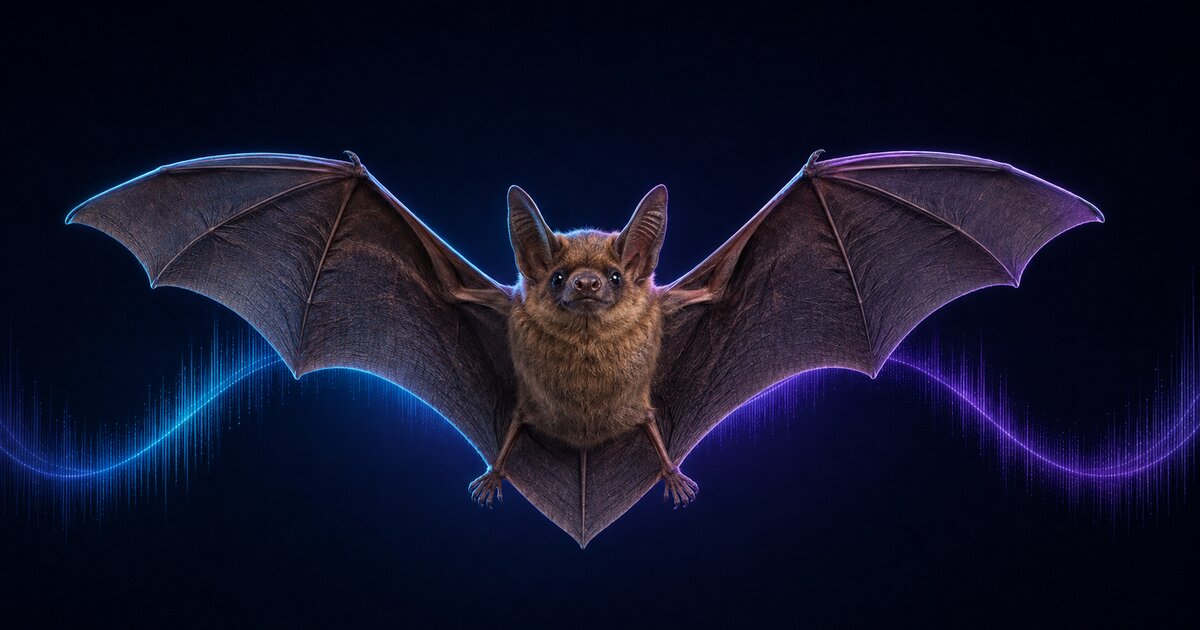
Eptesicus fuscus
It hunts in the dark by reading the echo of its own shouts, five times above your ceiling.

In short
A Bat hears from about 2.6 kHz up to 100 kHz, and the pitch it catches best is near 20 kHz. Animal Ears lets you take any sound of yours and hear it exactly as it would.
The big brown bat reaches 100,000 Hz, five times your limit, and yet barely hears below 2,600 Hz: low sounds don't interest it in the slightest. Its whole ear is built for one job: shout in ultrasound and listen to the echo coming back. From that echo it works out how far away a moth is, which way it's going and how fast, in total darkness, dozens of times a second.
Hertz (Hz)
Which pitches it hears
Hertz count how many times per second a sound vibrates. Few vibrations = low (the rumble of thunder, about 30 Hz). Many vibrations = high (a microwave beeping, about 3,000 Hz). And ‘1 kHz' is just shorthand for 1,000 Hz. You hear, roughly, from 20 Hz to 20,000 Hz.
A low sound rumbles (think thunder); a high sound squeals (think a mosquito). These three numbers mark how far down this animal goes, how far up it goes, and which pitch it hears most clearly of all.
| Lowest it hears | 2.6 kHz |
|---|---|
| Highest it hears | 100 kHz |
| Hears most clearly | 20 kHz |
| What you hear | 20 Hz – 20 kHz |
Your ears vs a Bat's
Yes: it picks up pitches so high they are pure silence to you, up to about 100 kHz. Your ceiling is 20 kHz.
Audiogram
| Hertz (Hz) | Hearing threshold |
|---|---|
| 1 kHz | 100 dB |
| 2 kHz | 75 dB |
| 3 kHz | 55 dB |
| 5 kHz | 35 dB |
| 10 kHz | 18 dB |
| 15 kHz | 11 dB |
| 20 kHz | 7 dB |
| 30 kHz | 16 dB |
| 45 kHz | 33 dB |
| 60 kHz | 26 dB |
| 80 kHz | 42 dB |
| 100 kHz | 60 dB |
| 120 kHz | 83 dB |
Average conditioned-avoidance audiogram of 3 bats; best 7 dB at 20 kHz with a dip near 45 kHz; 60 dB SPL limits (~2.6–100 kHz).
Can a Bat hear things you can't?
A Bat picks up everything from 2.6 kHz (the deepest) to 100 kHz (the highest), and hears best around 20 kHz.
Yes: it picks up pitches so high they are pure silence to you, up to about 100 kHz. Your ceiling is 20 kHz.
Frequently asked questions
What sounds can a Bat hear?
A Bat picks up everything from 2.6 kHz (the deepest) to 100 kHz (the highest), and hears best around 20 kHz.
Can a Bat hear things you can't?
Yes: it picks up pitches so high they are pure silence to you, up to about 100 kHz. Your ceiling is 20 kHz.
How does Animal Ears make a sound like a Bat would hear it?
Scientists have measured, pitch by pitch, the quietest volume at which a Bat starts to hear each sound. We take that curve and apply it to your recording like a giant equaliser: we turn up the pitches the animal hears beautifully and turn down or remove the ones that simply don't exist for it. The result gets close to what it would notice... but it still arrives through your ears.
Hertz (Hz)
Hertz count how many times per second a sound vibrates. Few vibrations = low (the rumble of thunder, about 30 Hz). Many vibrations = high (a microwave beeping, about 3,000 Hz). And ‘1 kHz' is just shorthand for 1,000 Hz. You hear, roughly, from 20 Hz to 20,000 Hz.
Ultrasound
Sounds so high your ears no longer register them: above about 20,000 Hz. To you they are total silence, but a dog, a cat or a bat hears them perfectly. That's exactly where a ‘silent' dog whistle lives.
Where these numbers come from
- Koay, G., Heffner, H.E. & Heffner, R.S. (1997). Audiogram of the big brown bat. Hearing Research, 105(1–2), 202–210. doi:10.1016/S0378-5955(96)00208-0
- Fay, R.R. (1988). Hearing in Vertebrates: A Psychophysics Databook. Hill-Fay Associates.
More animals
Mouse
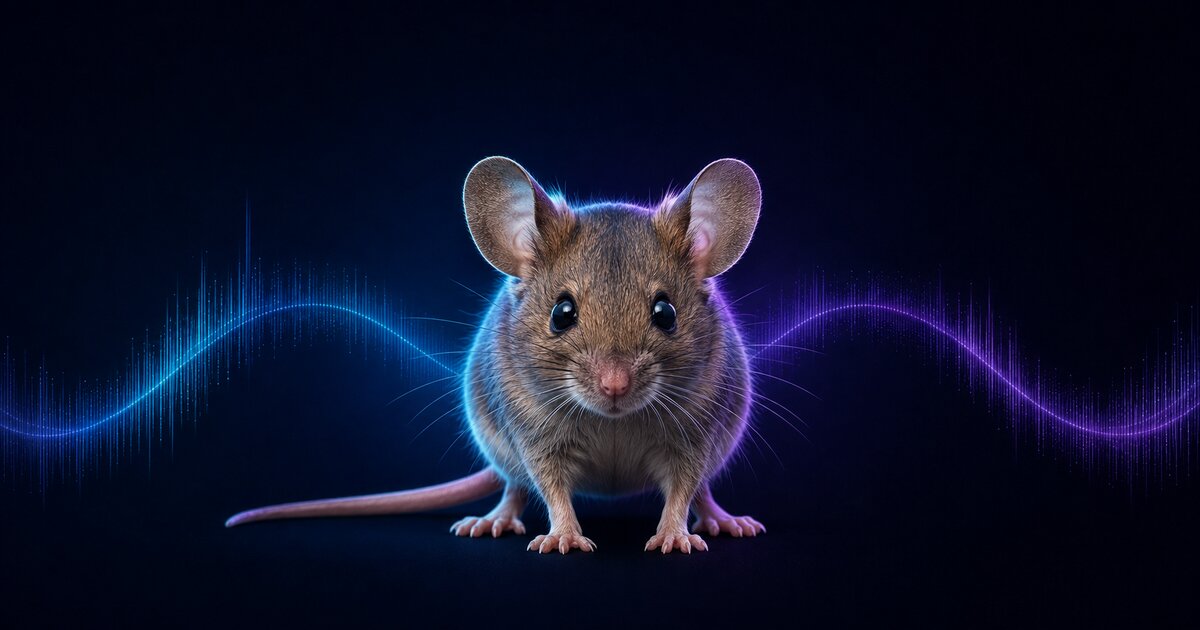
It lives one floor above you: nearly deaf to your voice, razor-sharp in ultrasound.

Cat
It reaches nearly four times higher than you: it hears mice talking on a private channel.

Tiger
A house cat's ears scaled up, plus a roar you feel before you hear it.

Ferret
It hunts in pitch-dark tunnels, guided by its prey's high-pitched squeaks.
Animal Ears
Get Animal Ears
Upload a sound of your own and hear it exactly as an animal would.